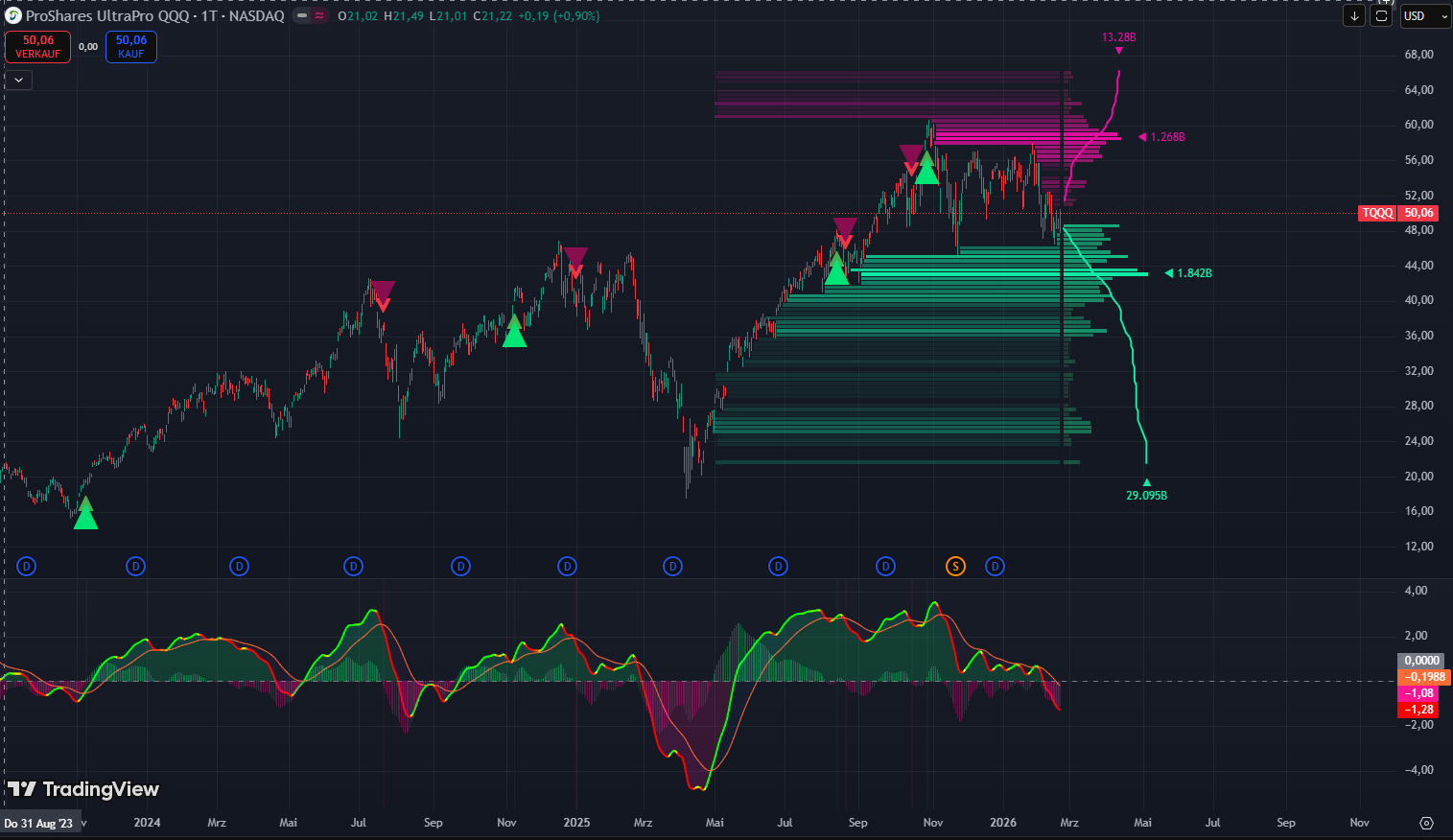
Weekly NASDAQ Model Update - Feb 21, 2026: +27% CAGR Since 1999 - Today’s Signals & Stance
Our Tactical NASDAQ Model turned $10K into over $6 million with 27% annual returns since 1999 - crushing the NASDAQ. This week’s update reveals the model’s current position, market signals, and more.

📅 Date: 21.02.2026
🛡️ The big picture
Weeks like this are exactly why the Playbook exists. When the Nasdaq turns into a fast, whipsawing correction tape, most traders lose money by doing “a little bit” too often. In a 3x product, that is how you bleed.
Our rule-based engine has done its job well: it has kept capital largely out of the chop while the market has been repricing risk, compressing multiples, and reacting to headlines. That is not boring. That is the whole game. You do not need to catch every bounce. You need to avoid the period where the market is paying you poorly for taking risk.
📈 What happened in the Nasdaq-100 this week
The Nasdaq-100 finished the holiday-shortened week higher, up about +1.13% from 24,732.73 (Feb 13) to 25,012.62 (Feb 20).
The path mattered more than the weekly number. The tape stayed jumpy, but we did get incremental improvement in volatility. VXN closed at 24.23 on Friday, down from 26.37 the prior Friday. That is a step in the right direction, but still not what I would call a clean trend regime.
The main catalyst was Friday. Stocks popped after news that the U.S. Supreme Court struck down Trump’s sweeping tariffs, which created a relief move into the close. It helped sentiment, but it does not automatically fix the underlying structure. One headline can lift prices for a day. A trend needs follow-through.
🔭 What matters next week
One event is likely to dominate Nasdaq sentiment: Nvidia earnings on Wednesday, Feb 25 after the close. In this market, AI leadership is acting like a mood ring for risk appetite. If Nvidia is strong and the tape holds the reaction, that can stabilize the index. If it disappoints or guides cautiously, it can easily reprice risk again.
For the Playbook, the checklist stays simple:
Close quality improves and green days stop fading late
Volatility keeps compressing instead of re-spiking
Leadership stabilizes for more than one session at a time
If those conditions improve, the engine starts lighting up again. If they do not, staying defensive remains the correct trade.
🔒 Paid members get the live model allocation.
What we do: One instrument (TQQQ). Three fixed-weight engines (Core 50%, Momentum 25%, Short-Term 25%). Each is ON/OFF only, executed end-of-day. The equity curve since 1999 speaks for itself: ~27% per year(~65,000% cumulative). That compounding happens by being in durable trends and flat when the tape is fragile.
If you're serious about compounding wealth with discipline, now’s the time.
🟢 $0.60 a day.
🟢 Cancel anytime.
🟢 Join hundreds who stopped guessing and started operating.
🧩 Signal Check - Three-Model Dashboard
We run through all three models - Core 50%, Momentum 25%, Short-Term 25% -what moved, what’s one box from flipping, and the exact EOD confirmation we’re waiting on.
📘 Base Momentum Model